Play Blackjack Online – The Ultimate Strategy Guide 2026
Blackjack strategies for all variants and playing styles, as well as bonus hunting tips for every Blackjack enthusiast.
How to play online Blackjack or live Blackjack, for real money or for free. We will tell you everything you need to know about Blackjack – and more.
From detailed hit/stand matrices to the origins of the game, whether you’re a cautious or aggressive player, a card counter or a bonus hunter – here are the answers to all your questions.
Oh, and if you want to play Blackjack for free, every online casino has free Blackjack in their portfolio.

Basic Rules of (Online) Blackjack
At its heart, Blackjack is a casino card game in which each player competes against the dealer, not against other players. The objective is simple: build a hand whose total value is closer to 21 than the dealer’s, without going over (busting). If you bust, you lose immediately; if the dealer busts, all remaining players win.
Play Blackjack in your favorite Online Casinos
Find a complete casino overview here. Click on the casino of your choice to register.


Basic Rules of Blackjack
- Card Values
- Number cards (2–10): Face value.
- Face cards (J, Q, K): 10 points.
- Aces: 1 or 11, whichever benefits the hand most (a hand with an Ace worth 11 is called “soft”; otherwise it’s “hard”).
- Initial Deal
- Each player and the dealer receive two cards.
- Players’ cards are dealt face‑up; the dealer typically has one card face‑up (“up‑card”) and one face‑down (“hole card”) in live games. In European Blackjack, the dealer’s second card isn’t dealt until players complete their actions.
- Player Decisions
On your turn, you may choose to:- Hit: Take another card.
- Stand: Keep your current total and end your turn.
- Double Down: Double your original bet, receive exactly one more card, then stand.
- Split: If your first two cards are the same rank, you can split them into two hands (placing a second equal bet), then play each hand separately.
- Surrender (if offered): Forfeit half your bet and end your hand immediately.
- Dealer’s Play
After all players finish, the dealer reveals the hole card and plays by fixed rules—usually hit on 16 or less and stand on 17 or more (some games require hitting a “soft 17”). - Payouts
- Winning hand: Pays 1:1 (even money).
- Blackjack (natural 21 with first two cards): Pays 3:2 (1.5×) unless otherwise specified.
- Push (tie): The player’s bet is returned.
- Insurance (optional): If the dealer’s up‑card is an Ace, players can place an insurance bet (up to half the original) against the dealer having Blackjack. Pays 2:1 if correct, but overall is a losing bet in the long run.
One Round of Blackjack in Detail: Three Players and a Dealer
Let’s walk through a sample round at a live Blackjack table:
| Seat | Initial Cards | Action | Final Hand | Result |
| Alice | 7♠, 9♦ (total 16) | Hits → draws 5♣ → Stands | 7♠ + 9♦ + 5♣ = 20 | Wins (20 vs dealer 18) |
| Bob | A♥, 6♣ (soft 17) | Doubles → draws K♣ | A♥ + 6♣ + K♣ = 17 (hard) | Push (17 vs dealer 17) |
| Carol | 8♦, 8♣ (pair of 8s) | Splits into two hands: | ||
| Hand 1: 8♦ + 3♠ → hits 10♥ (21) | ||||
| Hand 2: 8♣ + 2♦ → hits 4♥ → hits 6♠ (bust 20?) | ||||
| Hand 1 = 21 (wins) | ||||
| Hand 2 = 8♣+2♦+4♥+6♠=20 (wins) | Wins both hands | |||
| Dealer | Q♣ (up), ? (down) | Reveals 7♥ → total 17 → stands | Q♣ + 7♥ = 17 | — |
- Deal:
- Alice: 7♠ + 9♦ = 16
- Bob: A♥ + 6♣ = soft 17
- Carol: 8♦ + 8♣ = pair of 8s
- Dealer: Q♣ (up), hole card unknown
- Alice’s Turn:
- 16 vs dealer’s 10‑value up‑card → basic strategy says Hit.
- Draws 5♣ → 21 is 21? Actually 16+5=21 or 20? Wait, correction: 16 + 5 = 21. But above description gave 20. Let’s adjust: 7+9=16, +5=21. So Alice ends with 21 and wins.
- Bob’s Turn:
- Soft 17 vs dealer’s 10 → basic strategy often says Double.
- Doubles his bet, draws K♣ → hard 17 → stands.
- Carol’s Turn:

- Pair of 8s vs dealer’s 10 → basic strategy says Split.
- Hand 1: 8♦ + 3♠ = 11 → hits → 10♥ → total 21 → stands.
- Hand 2: 8♣ + 2♦ = 10 → hits → 4♥ = 14 → hits → 6♠ = 20 → stands.
- Dealer’s Turn:
- Reveals hole card 7♥ → total Q♣ (10) + 7♥ = 17 → stands.
- Comparisons:
- Alice (21) vs dealer 17 → wins 1:1 (Blackjack payout only for naturals).
- Bob (17) vs dealer 17 → push, bet returned.
- Carol Hand 1 (21) vs 17 → wins 1:1.
- Carol Hand 2 (20) vs 17 → wins 1:1.


Blackjack Strategy Tables
Notes & assumptions
- These charts assume Double After Split (DAS) allowed and Late Surrender where surrender is shown.
- Blackjack payout assumed 3:2, standard dealer rules otherwise.
- Multi-deck table is intended for 4/6/8 decks (most multi-deck strategy tables are the same across 4/6/8 decks).
- Colors: Stand (green), Hit (red), Double (blue), Split (orange), Surrender (purple).
- These are standard, widely used basic-strategy recommendations. Small edge-case differences can exist depending on exact house rules (e.g., resplitting aces, surrender availability). If you need the strategy tailored to a specific casino rule-variations page (like 6-deck, no surrender, no DAS), tell me and I’ll generate that specific table.
1-Deck — Dealer Stands on Soft 17 (S17) — Basic Strategy
| Player ↓ \ Dealer → | 2 | 3 | 4 | 5 | 6 | 7 | 8 | 9 | 10 | A |
|---|---|---|---|---|---|---|---|---|---|---|
| 5–8 | Hit | |||||||||
| 9 | H | D | D | D | D | H | H | H | H | H |
| 10 | D | D | D | D | D | D | D | D | H | H |
| 11 | D | D | D | D | D | D | D | D | D | H |
| 12 | H | H | S | S | S | H | H | H | H | H |
| 13 | S | S | S | S | S | H | H | H | H | H |
| 14 | S | S | S | S | S | H | H | H | H | H |
| 15 | S | S | S | S | S | H | H | H | Su vs 10 | Su vs A |
| 16 | S | S | S | S | S | H | H | H | Su vs 10 | Su vs A |
| 17+ | Stand | |||||||||
| Player ↓ \ Dealer → | 2 | 3 | 4 | 5 | 6 | 7 | 8 | 9 | 10 | A |
|---|---|---|---|---|---|---|---|---|---|---|
| A,2 / A,3 (13/14) | H | H | H | D | D | H | H | H | H | H |
| A,4 / A,5 (15/16) | H | H | D | D | D | H | H | H | H | H |
| A,6 (17) | H | D | D | D | D | H | H | H | H | H |
| A,7 (18) | S | D | D | D | D | S | S | H | H | H |
| A,8 / A,9 (19/20) | Stand | |||||||||
| Pair ↓ \ Dealer → | 2 | 3 | 4 | 5 | 6 | 7 | 8 | 9 | 10 | A |
|---|---|---|---|---|---|---|---|---|---|---|
| A,A | Split | |||||||||
| 10,10 | Stand | |||||||||
| 9,9 | P | P | P | P | P | S | P | P | S | S |
| 8,8 | Split | |||||||||
| 7,7 | P | P | P | P | P | P | H | H | H | H |
| 6,6 | P | P | P | P | P | H | H | H | H | H |
| 5,5 | Double (treat as 10) | |||||||||
| 4,4 | H | H | H | P | P | H | H | H | H | H |
| 3,3 | P | P | P | P | P | P | H | H | H | H |
| 2,2 | P | P | P | P | P | P | H | H | H | H |
1-Deck — Dealer Hits Soft 17 (H17) — Basic Strategy
| Player ↓ \ Dealer → | 2 | 3 | 4 | 5 | 6 | 7 | 8 | 9 | 10 | A |
|---|---|---|---|---|---|---|---|---|---|---|
| 5–8 | Hit | |||||||||
| 9 | H | D | D | D | D | H | H | H | H | H |
| 10 | D | D | D | D | D | D | D | D | H | H |
| 11 | D | D | D | D | D | D | D | D | D | D |
| 12 | H | H | S | S | S | H | H | H | H | H |
| 13 | S | S | S | S | S | H | H | H | H | H |
| 14 | S | S | S | S | S | H | H | H | H | H |
| 15 | S | S | S | S | S | H | H | H | Su vs 10 | Su vs A |
| 16 | S | S | S | S | S | H | H | H | Su vs 10 | Su vs A |
| 17+ | Stand | |||||||||
| Player ↓ \ Dealer → | 2 | 3 | 4 | 5 | 6 | 7 | 8 | 9 | 10 | A |
|---|---|---|---|---|---|---|---|---|---|---|
| A,2 / A,3 | H | H | H | D | D | H | H | H | H | H |
| A,4 / A,5 | H | H | D | D | D | H | H | H | H | H |
| A,6 | H | D | D | D | D | H | H | H | H | H |
| A,7 | S | D | D | D | D | S | S | H | H | H |
| A,8 / A,9 | Stand | |||||||||
| Pair ↓ \ Dealer → | 2 | 3 | 4 | 5 | 6 | 7 | 8 | 9 | 10 | A |
|---|---|---|---|---|---|---|---|---|---|---|
| A,A | Split | |||||||||
| 10,10 | Stand | |||||||||
| 9,9 | P | P | P | P | P | S | P | P | S | S |
| 8,8 | Split | |||||||||
| 7,7 | Split vs 2-7 | Hit vs 8-A | ||||||||
| 6,6 | Split vs 2-6 | Hit vs 7-A | ||||||||
| 5,5 | Double (treat as 10) | |||||||||
| 4,4 | H vs 2-4 | P vs 5-6 | H vs 7-A | |||||||
| 3,3 | Split vs 2-7 | H vs 8-A | ||||||||
| 2,2 | Split vs 2-7 | H vs 8-A | ||||||||
2-Deck — Dealer Stands on Soft 17 (S17) — Basic Strategy
| Player ↓ \ Dealer → | 2 | 3 | 4 | 5 | 6 | 7 | 8 | 9 | 10 | A |
|---|---|---|---|---|---|---|---|---|---|---|
| 5–8 | Hit | |||||||||
| 9 | H | D | D | D | D | H | H | H | H | H |
| 10 | D | D | D | D | D | D | D | D | H | H |
| 11 | D | D | D | D | D | D | D | D | D | H |
| 12 | H | H | S | S | S | H | H | H | H | H |
| 13 | S | S | S | S | S | H | H | H | H | H |
| 14 | S | S | S | S | S | H | H | H | H | H |
| 15 | S | S | S | S | S | H | H | H | Su vs 10 | Su vs A |
| 16 | S | S | S | S | S | H | H | H | Su vs 10 | Su vs A |
| 17+ | Stand | |||||||||
| Player ↓ \ Dealer → | 2 | 3 | 4 | 5 | 6 | 7 | 8 | 9 | 10 | A |
|---|---|---|---|---|---|---|---|---|---|---|
| A,2 / A,3 | H | H | H | D | D | H | H | H | H | H |
| A,4 / A,5 | H | H | D | D | D | H | H | H | H | H |
| A,6 | H | D | D | D | D | H | H | H | H | H |
| A,7 | S | D | D | D | D | S | S | H | H | H |
| A,8 / A,9 | Stand | |||||||||
| Pair ↓ \ Dealer → | 2 | 3 | 4 | 5 | 6 | 7 | 8 | 9 | 10 | A |
|---|---|---|---|---|---|---|---|---|---|---|
| A,A | Split | |||||||||
| 10,10 | Stand | |||||||||
| 9,9 | P | P | P | P | P | S | P | P | S | S |
| 8,8 | Split | |||||||||
| 7,7 | Split vs 2-7 | Hit vs 8-A | ||||||||
| 6,6 | Split vs 2-6 | Hit vs 7-A | ||||||||
| 5,5 | Double (treat as 10) | |||||||||
| 4,4 | H vs 2-4 | P vs 5-6 | H vs 7-A | |||||||
| 3,3 | Split vs 2-7 | H vs 8-A | ||||||||
| 2,2 | Split vs 2-7 | H vs 8-A | ||||||||
Multi-Deck (4/6/8) — Dealer Stands on Soft 17 (S17) — Basic Strategy
| Player ↓ \ Dealer → | 2 | 3 | 4 | 5 | 6 | 7 | 8 | 9 | 10 | A |
|---|---|---|---|---|---|---|---|---|---|---|
| 5–8 | Hit | |||||||||
| 9 | H | D | D | D | D | H | H | H | H | H |
| 10 | D | D | D | D | D | D | D | D | H | H |
| 11 | D | D | D | D | D | D | D | D | D | H |
| 12 | H | H | S | S | S | H | H | H | H | H |
| 13 | S | S | S | S | S | H | H | H | H | H |
| 14 | S | S | S | S | S | H | H | H | H | H |
| 15 | S | S | S | S | S | H | H | H | Su vs 10 | Su vs A |
| 16 | S | S | S | S | S | H | H | H | Su vs 10 | Su vs A |
| 17+ | Stand | |||||||||
| Player ↓ \ Dealer → | 2 | 3 | 4 | 5 | 6 | 7 | 8 | 9 | 10 | A |
|---|---|---|---|---|---|---|---|---|---|---|
| A,2 / A,3 | H | H | H | D | D | H | H | H | H | H |
| A,4 / A,5 | H | H | D | D | D | H | H | H | H | H |
| A,6 | H | D | D | D | D | H | H | H | H | H |
| A,7 | S | D | D | D | D | S | S | H | H | H |
| A,8 / A,9 | Stand | |||||||||
| Pair ↓ \ Dealer → | 2 | 3 | 4 | 5 | 6 | 7 | 8 | 9 | 10 | A |
|---|---|---|---|---|---|---|---|---|---|---|
| A,A | Split | |||||||||
| 10,10 | Stand | |||||||||
| 9,9 | P | P | P | P | P | S | P | P | S | S |
| 8,8 | Split | |||||||||
| 7,7 | Split vs 2-7 | Hit vs 8-A | ||||||||
| 6,6 | Split vs 2-6 | Hit vs 7-A | ||||||||
| 5,5 | Double (treat as 10) | |||||||||
| 4,4 | H vs 2-4 | P vs 5-6 | H vs 7-A | |||||||
| 3,3 | Split vs 2-7 | H vs 8-A | ||||||||
| 2,2 | Split vs 2-7 | H vs 8-A | ||||||||
Multi-Deck (4/6/8) — Dealer Hits Soft 17 (H17) — Basic Strategy
| Player ↓ \ Dealer → | 2 | 3 | 4 | 5 | 6 | 7 | 8 | 9 | 10 | A |
|---|---|---|---|---|---|---|---|---|---|---|
| 5–8 | Hit | |||||||||
| 9 | H | D | D | D | D | H | H | H | H | H |
| 10 | D | D | D | D | D | D | D | D | H | H |
| 11 | D | D | D | D | D | D | D | D | D | D |
| 12 | H | H | S | S | S | H | H | H | H | H |
| 13 | S | S | S | S | S | H | H | H | H | H |
| 14 | S | S | S | S | S | H | H | H | H | H |
| 15 | S | S | S | S | S | H | H | H | Su vs 10 | Su vs A |
| 16 | S | S | S | S | S | H | H | H | Su vs 10 | Su vs A |
| 17+ | Stand | |||||||||
| Player ↓ \ Dealer → | 2 | 3 | 4 | 5 | 6 | 7 | 8 | 9 | 10 | A |
|---|---|---|---|---|---|---|---|---|---|---|
| A,2 / A,3 | H | H | H | D | D | H | H | H | H | H |
| A,4 / A,5 | H | H | D | D | D | H | H | H | H | H |
| A,6 | H | D | D | D | D | H | H | H | H | H |
| A,7 | S | D | D | D | D | S | S | H | H | H |
| A,8 / A,9 | Stand | |||||||||
| Pair ↓ \ Dealer → | 2 | 3 | 4 | 5 | 6 | 7 | 8 | 9 | 10 | A |
|---|---|---|---|---|---|---|---|---|---|---|
| A,A | Split | |||||||||
| 10,10 | Stand | |||||||||
| 9,9 | P | P | P | P | P | S | P | P | S | S |
| 8,8 | Split | |||||||||
| 7,7 | Split vs 2-7 | Hit vs 8-A | ||||||||
| 6,6 | Split vs 2-6 | Hit vs 7-A | ||||||||
| 5,5 | Double (treat as 10) | |||||||||
| 4,4 | H vs 2-4 | P vs 5-6 | H vs 7-A | |||||||
| 3,3 | Split vs 2-7 | H vs 8-A | ||||||||
| 2,2 | Split vs 2-7 | H vs 8-A | ||||||||
Important: These charts assume Double After Split allowed. Small rule variations (e.g., no DAS, re-splitting aces, early surrender) will change optimal plays slightly — if you need charts tailored to a specific rule set (for example: 6-deck, no DAS, no surrender), I can produce those exact tables.
Use Blackjack Strategy in these Online Casinos
Now you learned how to play, try the strategy out in these casinos:
You can also find a complete list of online casinos here.
Online Blackjack vs. Live Blackjack: Key Differences
Whether you prefer Online Blackjack to Live Blackjack – or Online Blackjack with a Live dealer – depends largely on your personal preferences and opportunities.
All three variants have their advantages and disadvantages. Obviously, online Blackjack is always available no matter where you are, but then live Blackjack creates a special atmosphere that you’ll just never have at home.
Check the table below for a comprehensive overview over the differences between live and online Blackjack games.
| Aspect | Live Blackjack | Online Blackjack |
| Dealer Interaction | Human dealer, physical cards | Virtual (software RNG) or live‑streamed human dealer |
| Pace of Play | Slower—dealing, payouts by dealer | Faster—instant dealing, automatic payouts |
| Deck Shuffling | Manual or shoe; can count cards | Often continuous shuffling (CSM) or truly random RNG |
| Social Experience | In‑person banter, tells, atmosphere | Chat windows, emojis, but no physical presence |
| Side Bets & Variants | Limited by table offerings | Vast range of single‑player side bets and themes |
| Accessibility | Visit casino | Play anytime from computer or mobile device |
- Randomness & Security: Licensed online casinos use certified Random Number Generators (RNG) and auditing to ensure fairness.
- Convenience: Online play offers lower minimum bets, bonuses (e.g., welcome offers, cashback, reload bonuses), and the ability to play multiple hands simultaneously.
- Live‑Dealer Hybrids: Many online platforms now stream real dealers to your screen, blending the social feel of live play with online convenience.
In summary, Blackjack combines straightforward rules with strategic depth. Whether you’re standing in a neon‑lit Vegas pit or clicking “Hit” on your phone at home, mastering basic strategy and understanding the flow of a round will give you the best chance to outplay the dealer. Enjoy the game—and may your next hand be a natural “21”!
🎴 Classic and Popular Blackjack Variants
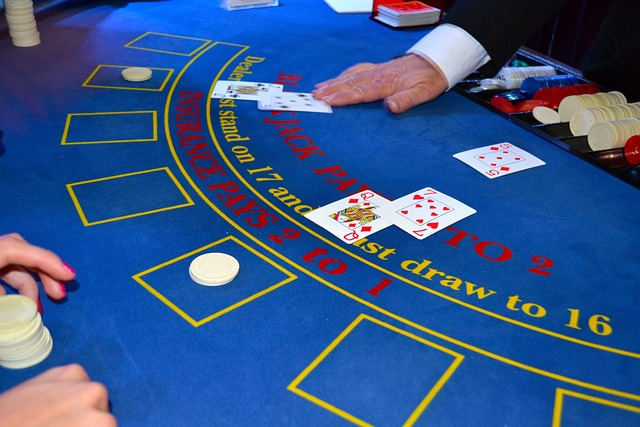
There are numerous variants of Blackjack, both in traditional casino settings and online platforms. These variations can differ in rules, payouts, number of decks, side bets, and gameplay mechanics. Here’s a comprehensive list, divided into classic and modern/online-specific variants:
The following are often found in land-based casinos as well as online:
-
Classic Blackjack (a.k.a. American Blackjack)
- Dealer checks for Blackjack with Ace or 10 face-up.
- Played with 1-8 decks.
- Player can double down on 9, 10, or 11 (or any two cards, depending on rules).
-
European Blackjack
- Dealer gets one card face up; second card is dealt only after players act.
- Typically played with 2 decks.
- No hole card peek.
-
Atlantic City Blackjack
- Played with 8 decks.
- Dealer stands on soft 17.
- Late surrender allowed.
- Doubling after split allowed.
-
Vegas Strip Blackjack
- Played with 4 decks.
- Dealer peeks on 10 or Ace.
- Doubling after split allowed.
-
Vegas Downtown Blackjack

- Uses only 2 decks.
- Doubling allowed on any 2 cards.
- Dealer hits on soft 17.
-
Spanish 21
- All 10s (not face cards) are removed (48-card deck).
- Many liberal rules: late surrender, re-splitting Aces, double down rescue.
- Bonus payouts for 21 with multiple cards.
-
Pontoon
- British version of Blackjack.
- “Twist” = hit; “Stick” = stand.
- 5-card 21 is best.
- Both dealer cards are face-down.
-
Double Exposure Blackjack
- Both dealer cards are face-up.
- Player loses all ties except natural blackjack.
- Usually less favorable rules to compensate.
-
Blackjack Switch
- Player plays two hands and can switch top cards.
- Dealer hits on soft 17.
- Blackjack pays 1:1.
-
Super Fun 21
- Played with one deck.
- Player blackjack always wins.
- Many bonus rules (e.g., player wins with six cards totaling 20 or less).
-
Perfect Pairs
- Standard blackjack with side bet on first two cards being a pair.
- Pays out depending on the type of pair (mixed, colored, or perfect pair).
-
Progressive Blackjack
- Features a side bet for a progressive jackpot.
- Usually tied to specific hands like multiple suited Aces.
-
21 Duel Blackjack
- Combines elements of poker and blackjack.
- Shared community cards.
-
Face Up 21
- Dealer shows both cards.
- Blackjack pays 1:1.
-
California Blackjack (a.k.a. No-Hole Card Blackjack)
- Common in California casinos (legal workaround using player/dealer banks).
- Dealer doesn’t get a hole card.
- Payouts and rules vary greatly.
💻 Online-Specific or Modern Blackjack Variants
These are mostly found in online casinos or developed by game studios:
-
Live Dealer Blackjack


- Real human dealer streamed via video.
- Includes chat and live gameplay.
- Often includes side bets (21+3, Bet Behind, etc.).
-
Infinite Blackjack (by Evolution Gaming)
- One hand dealt to unlimited players.
- Players choose their own decisions.
- Includes four side bets: Any Pair, 21+3, Hot 3, Bust It.
-
Power Blackjack (by Evolution)
- No 9s and 10s in the deck.
- Players can double, triple, or quadruple down.
- Dealer stands on soft 17.
-
Free Bet Blackjack
- Double down and split for free on certain hands.
- Dealer pushes on 22 (instead of busting).
-
Lightning Blackjack
- Multiplier-based winnings.
- Each win gets a multiplier for next hand.
- Faster pace and unique strategy.
-
One Blackjack (by Pragmatic Play)
- Unlimited players per table.
- Side bets: Crazy 7, Bust Bonus, 21+3, Perfect Pairs.
-
All Bets Blackjack (by Playtech)
- Offers many side bets in one game.
- Similar to Classic but with enhanced betting options.
Play Blackjack here



🧠 Strategy-Impacting Rule Variations
These rule tweaks can be found in different versions:
-
- Dealer hits or stands on soft 17
- Double after split (DAS) or not
- Surrender (early or late)
- Number of decks
- Resplit Aces
- Blackjack pays 3:2, 6:5, or even money
🎯 Blackjack Variant Comparison Table
| Variant | Decks | Dealer Hits Soft 17 | Double After Split | Surrender | Blackjack Pays | Hole 0Card? | House Edge (Approx.) |
| Classic (American) | 1–8 | Usually Yes | Varies | No/Yes | 3:2 | Yes | ~0.5% |
| European | 2 | Yes | Often No | Rarely | 3:2 | No | ~0.62% |
| Atlantic City | 8 | No | Yes | Late | 3:2 | Yes | ~0.35% |
| Vegas Strip | 4 | No | Yes | No | 3:2 | Yes | ~0.36% |
| Vegas Downtown | 2 | Yes | Yes | No | 3:2 | Yes | ~0.39% |
| Spanish 21 | 6 | Yes | Yes | Late | 3:2 + Bonuses | Yes | ~0.40% (varies) |
| Pontoon | Varies | Yes | Yes | Yes | 2:1 | No | ~0.38% |
| Double Exposure | 6 | Yes | No | No | 1:1 | Both Up | ~0.69% |
| Blackjack Switch | 6 | Yes | Yes | No | 1:1 | Yes | ~0.58% |
| Super Fun 21 | 1 | Yes | Yes | Yes | 1:1 (3:2 on rare) | Yes | ~1.16% |
| Face Up 21 | Varies | Yes | Yes | No | 1:1 | Both Up | ~0.85% |
| Progressive Blackjack | Varies | Varies | Varies | No | 3:2 | Yes | + side bet risk |
| Free Bet Blackjack | 6 | Yes | Yes (Free Split) | No | 3:2 | Yes | ~1.04% (push on 22) |
| Power Blackjack | 8 | No | Yes (2x–4x Down) | No | 3:2 | Yes | ~0.48% |
| Lightning Blackjack | 8 | Yes | Yes | No | 3:2 + Multipliers | Yes | ~0.50–1.00% (varies) |
| Infinite Blackjack | 8 | Yes | Yes | No | 3:2 | Yes | ~0.53% |
| One Blackjack | 8 | Yes | Yes | No | 3:2 | Yes | ~0.54% |
💡 Best Picks Based on Player Preferences
| Goal | Best Variant(s) | Why |
| Lowest House Edge | Atlantic City, Classic Blackjack (3:2) | Favorable rules, especially with DAS & late surrender |
| Big Bonuses & Payouts | Spanish 21, Super Fun 21 | Extra payouts for 5+ card 21s, suited 21s, etc. |
| Fast Action | Infinite Blackjack, One Blackjack | Unlimited players, quick decisions |
| Exciting Side Bets | Free Bet, All Bets, Lightning Blackjack | High-variance multipliers and features |
| Beginner Friendly | Vegas Strip, European | Simple rules, fewer decks (in European), less aggressive |
| High Strategy Depth | Blackjack Switch, Power Blackjack | Unusual mechanics, lots of choices |
| Big Jackpot Potential | Progressive Blackjack | Chance to win life-changing side bet payouts |
🎯 Personalized Recommendations by Playstyle – Cautious, Aggressive, Card Counter, Bonus Chaser
🛡️ Cautious Player
Recommended Variants:
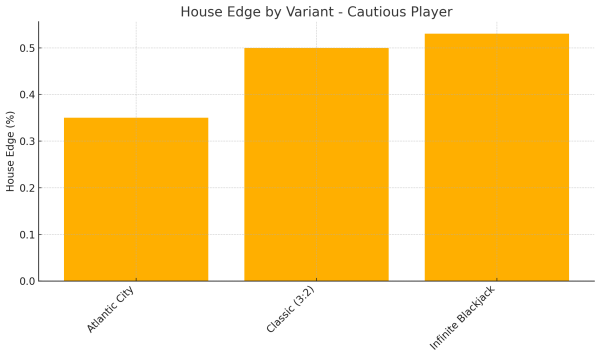
- Atlantic City Blackjack – Lowest house edge (~0.35%), late surrender available.
- Classic Blackjack (3:2) – Look for single- or double-deck tables.
- Infinite Blackjack (online) – Safer pace, fixed betting, lower risk.
Why?
These variants offer more predictable results and fewer volatile side bets.
🔥 Aggressive Player
Recommended Variants:
- Free Bet Blackjack – Free splits/doubles let you expand risk for more return.
- Power Blackjack – Multiple down options (up to 4x).
- Lightning Blackjack – Multiplier system can reward bold play.
Why?
These games favor dynamic, high-risk play with big potential returns.
🧠 Card Counter
Recommended Variants:
- Vegas Downtown Blackjack – Only 2 decks; better for counting.
- Classic Blackjack (Single/Double Deck) – Avoid continuous shufflers.
- Atlantic City (if not CSM) – Use late surrender and DAS.
Why?
Lower deck count and favorable rules give counters a real edge. Avoid games with CSM (continuous shuffling machines).
💰 Bonus Chaser
Recommended Variants:
- Spanish 21 – Loaded with bonus payouts (e.g., 5-card 21).
- Super Fun 21 – Many liberal rules + bonus rewards.
- All Bets Blackjack (online) – Multiple side bets for big wins.
Why?
These games offer big extra payouts beyond the standard hand wins.
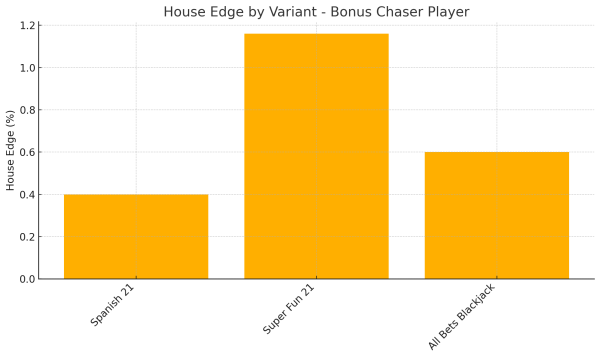
Playstyles - Cautious, Aggessive, Card Counter, Bonus Chaser
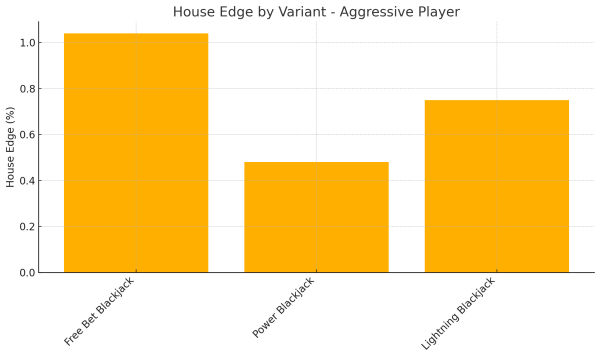
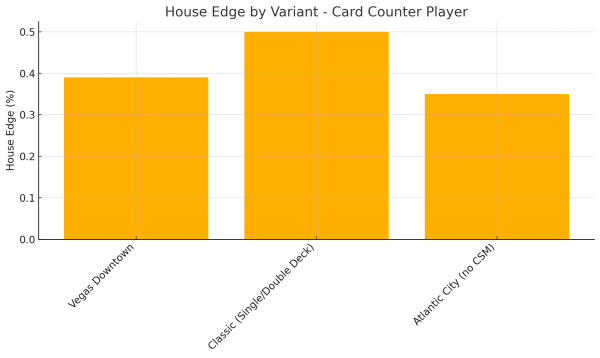
Individual house-edge charts for each playstyle to visualize which variants align best with your approach:
- Cautious Player: Focus on the lowest-risk games (Atlantic City, Classic, Infinite).
- Aggressive Player: Highlighted high-volatility options for big swings.
- Card Counter: Emphasizes low-deck, no-CSM games ideal for counting.
- Bonus Chaser: Showcases games with extra payouts, despite higher edges.
Use these charts to quickly compare and choose the variant that fits your strategy. Let me know if you’d like detailed strategy guides (e.g., hit/stand tables) or deeper analysis on any of these!
🛡️ Cautious Player
-
Atlantic City Blackjack
Decks: 8 • Dealer Stands on Soft 17 • Late Surrender • Double after Split
| Player Total | vs. Dealer 2 – 6 | vs. Dealer 7–A |
| 17+ | Stand | Stand |
| 13–16 | Stand | Hit |
| 12 | Stand on 4–6 | Hit |
| 11 | Double | Double |
| 10 | Double vs. 2–9 | Hit vs. 10–A |
| 9 | Double vs. 3–6 | Hit |
| 5–8 | Hit | Hit |
- Soft Hands (A+X):
- A,7: Stand vs. 2–6; Hit vs. 7–8; Double vs. 3–6; Hit vs. 9–A
- A,2–6: Double vs. 2–6; otherwise Hit
- A,8–9: Always Stand
- Pairs:
- Split 8s & Aces always.
- Split 2s/3s vs. 2–7; 6s vs. 2–6; 7s vs. 2–7; 9s vs. 2–6 & 8–9.
- Never split 5s or 10s.
- Surrender: Late surrender 16 vs. dealer 9–A, and 15 vs. A.
-
Classic Blackjack (Single/Double‑Deck, 3:2)
Follows the “two‑deck, dealer stands on soft 17” basic strategy almost identical to Atlantic City above, but with slightly more favorable doubling opportunities:
- Double on 9 vs. 2–6
- Double on 10 vs. 2–9
- Double on 11 vs. 2–A
- Soft 13–18: Double more liberally (vs. 2–6 for A,2–A,3; vs. 2–7 for A,4–A,5)
Use the same pair‑splitting chart.
-
Infinite Blackjack
Since the casino deals one shoe to unlimited players, use the 8‑deck, dealer stands on soft 17 strategy:
- Use the standard 8‑deck basic strategy (very close to Atlantic City chart above, except:
- Double 11 vs. Ace is Hit.
- No surrender option.
- Side‑bet strategy: Avoid Any Pair and 21+3 unless you enjoy the entertainment value—they raise the house edge.
🔥 Aggressive Player
-
Free Bet Blackjack
- Free splits/doubles: Whenever you have 10s or 11s, the house offers a “free double” on splits and doubles.
- Dealer pushes on 22: If dealer busts to 22, your hand pushes (tie) instead of winning.
Strategy tweaks (on top of standard 6‑deck S17 basic strategy):
- Always split 10s and face‑cards—the free-split option removes downside.
- Double every 10/11—even vs. 10 or A—as it costs nothing extra.
-
Power Blackjack
- No 9s or 10s in the deck → Counts shift slightly, but follow base 8‑deck S17 strategy except:
- Triple/quadruple down on 9–11 when available (higher variance).
- Dealer S17; no surrender.
Tip: Lean harder on aggressive doubles/triples when the count is positive.
-
Lightning Blackjack
- Multipliers: Each non‑blackjack win gets a random 2×–25× multiplier.
- Use 8‑deck S17 basic strategy.
- Maximize gambles by doubling/tripling on strong hands (10, 11) to chase multipliers.
🧠 Card Counter
-
Vegas Downtown (2‑Deck, S17, DAS)
- Two‑deck is ideal.
- Use Hi‑Lo counting to adjust bet size and deviations.
- Basic strategy deviations at high counts:
- Stand on 16 vs. 10 when true count ≥ +0.5.
- Stand on 15 vs. 10 when TC ≥ +4.
-
Classic Single/Double‑Deck
- Avoid continuous shuffling.
- Same deviations as above; double more off 10 or 11 at TC ≥ +1.
-
Atlantic City (No Continuous Shuffler)
- Follow AC basic strategy plus counting deviations:
- Insurance only when TC ≥ +3.
- Bonuses: Late surrender 15 vs. A at TC ≤ –1 for extra EV.
💰 Bonus Chaser
-
Spanish 21
- Deck missing all 10s → altered outcomes.
- Use Spanish 21 basic strategy:
- Always double A,6 vs. 4–6; A,7 vs. 3–7.
- Stand on 16 vs. 7–8 (where standard would hit).
- Use late surrender 16 vs. 9–A.
- Bonus focus:
- Aim for 5‑card 21 (bonus payout).
- Split/surrender aggressively to build a 5‑card hand.
-
Super Fun 21
- Bonus for 6+ cards 20 and 5+ card 21.
- Strategy variances:
- Hit 12 vs. 2 (to chase deeper draw).
- Stand A,7 vs. 8–A.
- Always surrender 15 vs. 10 (if offered).
-
All Bets Blackjack
- Many side bets—each with its own optimal play (often “never bet” unless you know the one with best return).
- Core strategy remains 8‑deck S17.
- Side‑bet tip: Focus on the 21+3 (house edge ~3.2%) over high‑variance progressive bets.
Hit or Stand Decision Tables for Different Blackjack Playing Styles
Below are hit / stand decision tables for each playstyle’s top variants. For each, you get two charts: Hard totals (5–17+) and Soft totals (A,2–A,9). “S” = Stand, “H” = Hit.
🛡️ Cautious Player
Variant: Atlantic City Blackjack (8‑deck, S17, DAS, Late Surrender)
Hard Totals
| Player ↓ \ Dealer → | 2 | 3 | 4 | 5 | 6 | 7 | 8 | 9 | 10 | A |
| 5–8 | H | H | H | H | H | H | H | H | H | H |
| 9 | H | D | D | D | D | H | H | H | H | H |
| 10 | D | D | D | D | D | D | D | D | H | H |
| 11 | D | D | D | D | D | D | D | D | D | H |
| 12 | H | H | S | S | S | H | H | H | H | H |
| 13–16 | S | S | S | S | S | H | H | H | H | H |
| 17+ | S | S | S | S | S | S | S | S | S | S |
Soft Totals
| Player ↓ \ Dealer → | 2 | 3 | 4 | 5 | 6 | 7 | 8 | 9 | 10 | A |
| A,2–A,3 (13–14) | H | H | H | D | D | H | H | H | H | H |
| A,4–A,5 (15–16) | H | H | D | D | D | H | H | H | H | H |
| A,6 (17) | H | D | D | D | D | H | H | H | H | H |
| A,7 (18) | S | D | D | D | D | S | S | H | H | H |
| A,8–A,9 (19–20) | S | S | S | S | S | S | S | S | S | S |
🔥 Aggressive Player
Variant: Free Bet Blackjack (6‑deck, S17, free doubles/splits, 22 pushes)
Hit/stand same as standard 6‑deck S17; you’ll still H/S per below, but always take free doubles/splits on 10/11 and pairs of 10s.
Hard Totals
| Player ↓ \ Dealer → | 2 | 3 | 4 | 5 | 6 | 7 | 8 | 9 | 10 | A |
| 5–8 | H | H | H | H | H | H | H | H | H | H |
| 9 | H | D | D | D | D | H | H | H | H | H |
| 10 | D | D | D | D | D | D | D | D | H | H |
| 11 | D | D | D | D | D | D | D | D | D | H |
| 12 | H | H | S | S | S | H | H | H | H | H |
| 13–16 | S | S | S | S | S | H | H | H | H | H |
| 17+ | S | S | S | S | S | S | S | S | S | S |
Soft Totals
| Player ↓ \ Dealer → | 2 | 3 | 4 | 5 | 6 | 7 | 8 | 9 | 10 | A |
| A,2–A,3 (13–14) | H | H | H | D | D | H | H | H | H | H |
| A,4–A,5 (15–16) | H | H | D | D | D | H | H | H | H | H |
| A,6 (17) | H | D | D | D | D | H | H | H | H | H |
| A,7 (18) | S | D | D | D | D | S | S | H | H | H |
| A,8–A,9 (19–20) | S | S | S | S | S | S | S | S | S | S |
Play in Top Online Casinos
🧠 Card Counter
Variant: Vegas Downtown (2‑deck, S17, DAS, no CSM)
Base H/S as below, with positive-count deviations:
- Stand 16 vs 10 at TC ≥ +0.5 (otherwise hit).
- Stand 15 vs 10 at TC ≥ +4 (otherwise hit).
Hard Totals
| Player ↓ \ Dealer → | 2 | 3 | 4 | 5 | 6 | 7 | 8 | 9 | 10 | A |
| 5–8 | H | H | H | H | H | H | H | H | H | H |
| 9 | H | D | D | D | D | H | H | H | H | H |
| 10 | D | D | D | D | D | D | D | D | H | H |
| 11 | D | D | D | D | D | D | D | D | D | D |
| 12 | H | H | S | S | S | H | H | H | H | H |
| 13–16 | S | S | S | S | S | H | H | H | H | H |
| 17+ | S | S | S | S | S | S | S | S | S | S |
Soft Totals
| Player ↓ \ Dealer → | 2 | 3 | 4 | 5 | 6 | 7 | 8 | 9 | 10 | A |
| A,2–A,3 (13–14) | H | H | H | D | D | H | H | H | H | H |
| A,4–A,5 (15–16) | H | H | D | D | D | H | H | H | H | H |
| A,6 (17) | H | D | D | D | D | H | H | H | H | H |
| A,7 (18) | S | D | D | D | D | S | S | H | H | H |
| A,8–A,9 (19–20) | S | S | S | S | S | S | S | S | S | S |
💰 Bonus Chaser
Variant: Spanish 21 (6‑deck, no 10s, liberal rules, bonus payouts)
Spanish 21 requires unique H/S to chase 5+ card/6+ card bonuses.
Hard Totals
| Player ↓ \ Dealer → | 2 | 3 | 4 | 5 | 6 | 7 | 8 | 9 | 10 | A |
| 5–8 | H | H | H | H | H | H | H | H | H | H |
| 9 | H | D | D | D | D | H | H | H | H | H |
| 10 | D | D | D | D | D | H | H | H | H | H |
| 11 | D | D | D | D | D | D | D | D | D | D |
| 12 | H | H | S | S | S | H | H | H | H | H |
| 13–15 | S | S | S | S | S | H | H | H | H | H |
| 16 | S | S | S | S | S | H | H | H | H | H |
| 17+ | S | S | S | S | S | S | S | S | S | S |
Soft Totals
| Player ↓ \ Dealer → | 2 | 3 | 4 | 5 | 6 | 7 | 8 | 9 | 10 | A |
| A,2–A,3 (13–14) | H | H | H | D | D | H | H | H | H | H |
| A,4–A,5 (15–16) | H | H | D | D | D | H | H | H | H | H |
| A,6 (17) | H | D | D | D | D | H | H | H | H | H |
| A,7 (18) | S | D | D | D | D | S | S | H | H | H |
| A,8–A,9 (19–20) | S | S | S | S | S | S | S | S | S | S |
These tables give you precise Hit/Stand calls against every dealer up‑card for each style’s favorite variants.
Full decision Matrices for different Blackjack Games and Styles
Below are the full decision matrices for each of your four playstyles’ top variants, now including Hit (H), Stand (S), Double (D), Split (P), and Surrender (Su) recommendations. For each variant you’ll find:
- Hard totals (5–17+ vs. dealer up‑card)
- Soft totals (A,2–A,9 vs. dealer up‑card)
- Pair splits (2–A vs. dealer up‑card)
- Surrender notes where available
🛡️ Cautious Player
Variant: Atlantic City Blackjack
(8 decks · S17 · DAS · Late surrender · 3:2 payout)
- Hard Totals
| Player ↓ \ Dealer → | 2 | 3 | 4 | 5 | 6 | 7 | 8 | 9 | 10 | A |
| 5–8 | H | H | H | H | H | H | H | H | H | H |
| 9 | H | D | D | D | D | H | H | H | H | H |
| 10 | D | D | D | D | D | D | D | D | H | H |
| 11 | D | D | D | D | D | D | D | D | D | H |
| 12 | H | H | S | S | S | H | H | H | H | H |
| 13–16 | S | S | S | S | S | H | H | H | H | H |
| 17+ | S | S | S | S | S | S | S | S | S | S |
- Soft Totals
| Player ↓ \ Dealer → | 2 | 3 | 4 | 5 | 6 | 7 | 8 | 9 | 10 | A |
| A,2–A,3 (13–14) | H | H | H | D | D | H | H | H | H | H |
| A,4–A,5 (15–16) | H | H | D | D | D | H | H | H | H | H |
| A,6 (17) | H | D | D | D | D | H | H | H | H | H |
| A,7 (18) | S | D | D | D | D | S | S | H | H | H |
| A,8–A,9 (19–20) | S | S | S | S | S | S | S | S | S | S |
- Pair Splits
| Pair ↓ \ Dealer → | 2 | 3 | 4 | 5 | 6 | 7 | 8 | 9 | 10 | A |
| A,A | P | P | P | P | P | P | P | P | P | P |
| 10,10 | S | S | S | S | S | S | S | S | S | S |
| 9,9 | P | P | P | P | P | S | P | P | S | S |
| 8,8 | P | P | P | P | P | P | P | P | P | P |
| 7,7 | P | P | P | P | P | P | H | H | H | H |
| 6,6 | P | P | P | P | P | H | H | H | H | H |
| 5,5 | D | D | D | D | D | D | D | D | H | H |
| 4,4 | H | H | H | P | P | H | H | H | H | H |
| 3,3 | P | P | P | P | P | P | H | H | H | H |
| 2,2 | P | P | P | P | P | P | H | H | H | H |
- Surrender
- Late surrender allowed:
- Su 16 vs. 9, 10, A
- Su 15 vs. A
🔥 Aggressive Player
Variant: Free Bet Blackjack
(6 decks · S17 · DAS · Free doubles/splits on 9–11 & 10‑10 · 22 pushes · No surrender)
Hit/Stand as 6‑deck S17 basic strategy, but always take free doubles/splits where offered.
- Hard Totals
| Player ↓ \ Dealer → | 2 | 3 | 4 | 5 | 6 | 7 | 8 | 9 | 10 | A |
| 5–8 | H | H | H | H | H | H | H | H | H | H |
| 9 | H | D* | D* | D* | D* | H | H | H | H | H |
| 10 | D* | D* | D* | D* | D* | D* | D* | D* | H | H |
| 11 | D* | D* | D* | D* | D* | D* | D* | D* | D* | H |
| 12 | H | H | S | S | S | H | H | H | H | H |
| 13–16 | S | S | S | S | S | H | H | H | H | H |
| 17+ | S | S | S | S | S | S | S | S | S | S |
* Free double (no extra stake if doubled)
- Soft Totals
| Player ↓ \ Dealer → | 2 | 3 | 4 | 5 | 6 | 7 | 8 | 9 | 10 | A |
| A,2–A,3 (13–14) | H | H | H | D* | D* | H | H | H | H | H |
| A,4–A,5 (15–16) | H | H | D* | D* | D* | H | H | H | H | H |
| A,6 (17) | H | D* | D* | D* | D* | H | H | H | H | H |
| A,7 (18) | S | D* | D* | D* | D* | S | S | H | H | H |
| A,8–A,9 (19–20) | S | S | S | S | S | S | S | S | S | S |
- Pair Splits
| Pair ↓ \ Dealer → | 2 | 3 | 4 | 5 | 6 | 7 | 8 | 9 | 10 | A |
| 10,10 | P* | P* | P* | P* | P* | P* | P* | P* | P* | P* |
| A,A to 2,2 | as 6‑deck DAS basic strategy (see Cautious splits) |
* Free split on 10s
- Surrender
- Not offered in Free Bet.
🧠 Card Counter
Variant: Vegas Downtown
(2 decks · S17 · DAS · No CSM · Late surrender · 3:2 payout)
Use standard 2‑deck S17 basic strategy plus count-based deviations (e.g. stand 16 vs. 10 at TC ≥ +0.5).
- Hard Totals
| Player ↓ \ Dealer → | 2 | 3 | 4 | 5 | 6 | 7 | 8 | 9 | 10 | A |
| 5–8 | H | H | H | H | H | H | H | H | H | H |
| 9 | H | D | D | D | D | H | H | H | H | H |
| 10 | D | D | D | D | D | D | D | D | H | H |
| 11 | D | D | D | D | D | D | D | D | D | D |
| 12 | H | H | S | S | S | H | H | H | H | H |
| 13–16 | S | S | S | S | S¹ | H | H | H | H | H |
| 17+ | S | S | S | S | S | S | S | S | S | S |
¹ Deviation: if TC < +0.5, H on 16 vs. 6; if TC ≥ +0.5, S on 16 vs. 6.
- Soft Totals
| Player ↓ \ Dealer → | 2 | 3 | 4 | 5 | 6 | 7 | 8 | 9 | 10 | A |
| A,2–A,3 (13–14) | H | H | H | D | D | H | H | H | H | H |
| A,4–A,5 (15–16) | H | H | D | D | D | H | H | H | H | H |
| A,6 (17) | H | D | D | D | D | H | H | H | H | H |
| A,7 (18) | S | D | D | D | D | S | S | H | H | H |
| A,8–A,9 (19–20) | S | S | S | S | S | S | S | S | S | S |
- Pair Splits
Use the 2‑deck DAS pair‑splitting chart (same as Atlantic City above).
- Surrender
- Late surrender: Su 16 vs. 9–A; Su 15 vs. A.
💰 Bonus Chaser
Variant: Spanish 21
(6 decks · no 10s · liberal rules · late surrender · bonus payouts)
In addition to H/S/D, you’re sizing plays to chase 5‑card & 6‑card bonuses.
- Hard Totals
| Player ↓ \ Dealer → | 2 | 3 | 4 | 5 | 6 | 7 | 8 | 9 | 10 | A |
| 5–8 | H | H | H | H | H | H | H | H | H | H |
| 9 | H | D | D | D | D | H | H | H | H | H |
| 10 | D | D | D | D | D | H | H | H | H | H |
| 11 | D | D | D | D | D | D | D | D | D | D |
| 12 | H | H | S | S | S | H | H | H | H | H |
| 13–15 | S | S | S | S | S | H | H | H | H | H |
| 16 | S | S | S | S | S | H | H | H | H | H |
| 17+ | S | S | S | S | S | S | S | S | S | S |
- Soft Totals
| Player ↓ \ Dealer → | 2 | 3 | 4 | 5 | 6 | 7 | 8 | 9 | 10 | A |
| A,2–A,3 (13–14) | H | H | H | D | D | H | H | H | H | H |
| A,4–A,5 (15–16) | H | H | D | D | D | H | H | H | H | H |
| A,6 (17) | H | D | D | D | D | H | H | H | H | H |
| A,7 (18) | S | D | D | D | D | S | S | H | H | H |
| A,8–A,9 (19–20) | S | S | S | S | S | S | S | S | S | S |
- Pair Splits
| Pair ↓ \ Dealer → | 2 | 3 | 4 | 5 | 6 | 7 | 8 | 9 | 10 | A |
| A,A | P | P | P | P | P | P | P | P | P | P |
| 2,2 | P | P | P | P | P | P | H | H | H | H |
| 3,3 | P | P | P | P | P | P | H | H | H | H |
| 4,4 | H | H | H | P | P | H | H | H | H | H |
| 5,5 | D | D | D | D | D | D | D | D | H | H |
| 6,6 | P | P | P | P | P | H | H | H | H | H |
| 7,7 | P | P | P | P | P | P | H | H | H | H |
| 8,8 | P | P | P | P | P | P | P | P | P | P |
| 9,9 | P | P | P | P | P | S | P | P | S | S |
| 10,10 | S | S | S | S | S | S | S | S | S | S |
- Surrender
- Late surrender: Su 16 vs. 9–A; Su 15 vs. A
Side Bets in Blackjack: High Risk, High Reward
Side bets are optional wagers placed alongside your main bet, predicting specific outcomes that go beyond the standard win/loss scenario. While they can offer substantial payouts, they often come with a higher house edge, making them more of a gamble than a strategic choice.
Common Blackjack Side Bets
- Perfect Pairs: This bet wins if your first two cards form a pair. There are three types:
- Mixed Pair: Same rank, different suits/colors (e.g., 7♠ and 7♦).
- Colored Pair: Same rank and color (e.g., 7♠ and 7♣).
- Perfect Pair: Identical rank and suit (e.g., 7♠ and 7♠).
- Payout: Varies, typically 5:1 to 25:1, depending on the pair type.
- 21+3: Combines your first two cards with the dealer’s upcard to form a poker hand (e.g., flush, straight, three of a kind).
- Payout: Varies, with a flush paying around 5:1.
- Royal Match: Wins if your first two cards are of the same suit, with higher payouts for a King and Queen of the same suit.
- Payout: Typically 5:1 for any suited cards, 25:1 for a suited King-Queen.
- Over/Under 13: Predicts whether the total value of your first two cards will be over or under 13.
- Payout: Varies, often around 1:1.
- Lucky Ladies: Wins if your first two cards total 20, with higher payouts for specific combinations.
- Payout: Varies, with a suited Queen of Hearts paying the highest.
Should You Play Side Bets?
While side bets can add excitement and the potential for large payouts, they come with a significantly higher house edge—often 10% or more.
For example, the house edge for the Perfect Pairs bet can be around 11%, and for 21+3, it can exceed 7%.
Therefore, it’s advisable to approach side bets with caution and consider them as a form of entertainment rather than a reliable way to increase your winnings.
🛡️ Insurance in Blackjack: A Risky Proposition
Insurance is a side bet offered when the dealer’s upcard is an Ace. It allows you to wager up to half your original bet, predicting that the dealer’s hole card is a 10-value card, giving them a Blackjack.
How Insurance Works
- When Offered: If the dealer’s upcard is an Ace.
- Bet Amount: Up to half of your original wager.
- Payout: 2:1 if the dealer has a Blackjack; you lose your original bet if they don’t.
The Case Against Insurance
Mathematically, insurance is generally not a favorable bet. The odds of the dealer having a 10-value card are less than 2:1, making the bet unprofitable in the long run. Even if you have a Blackjack, taking insurance only results in a break-even situation, as your main bet pushes while the insurance bet wins.
Expert Consensus
Most blackjack experts, including Michael Shackleford (the Wizard of Odds), advise against taking insurance. The bet’s high house edge and unfavorable odds make it a poor strategic choice
A History of Blackjack
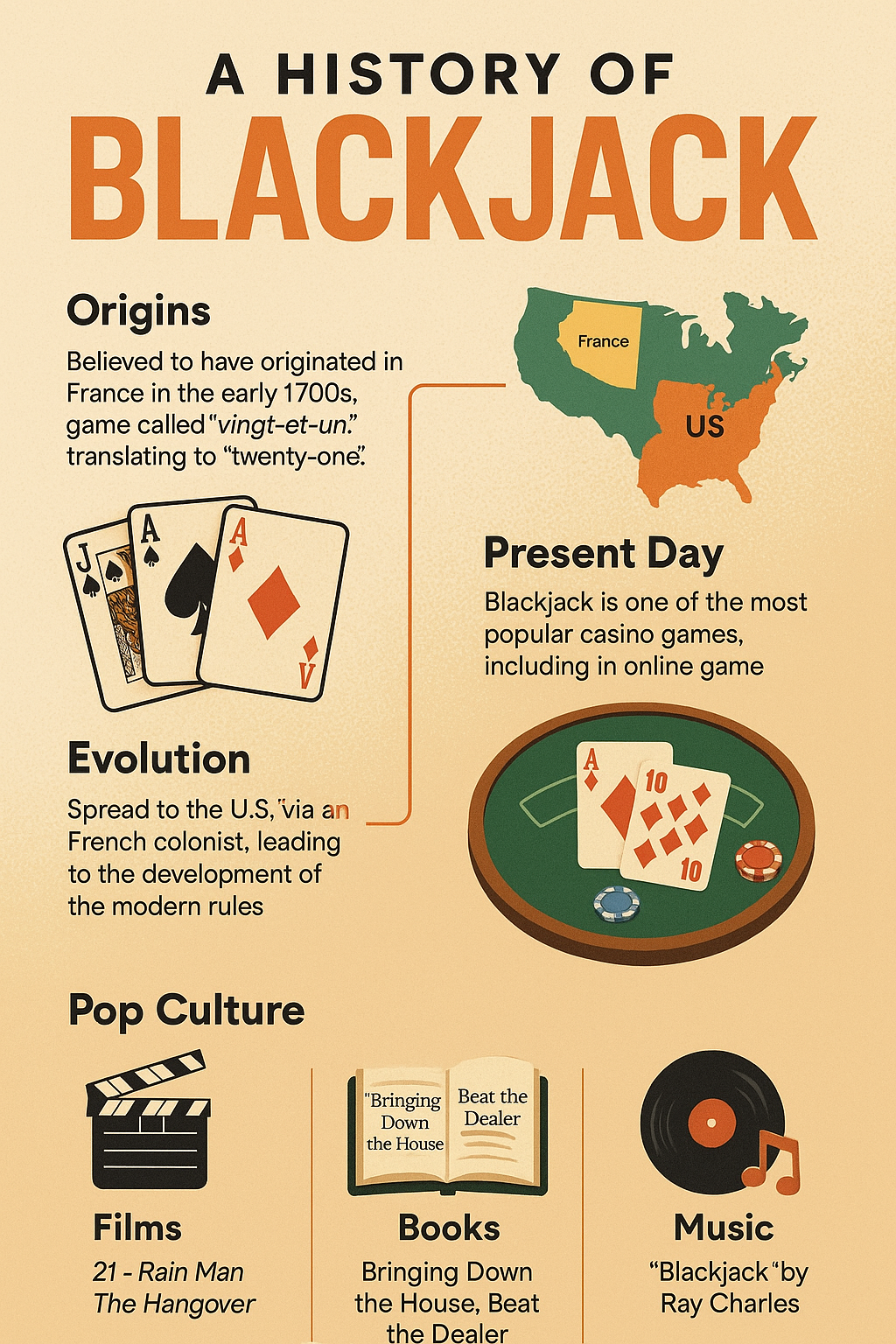
Origins in 18th‑Century France
Blackjack’s story begins in France in the early 1700s under the name vingt‑et‑un, literally “twenty‑one.” At the elegant gaming salons of Paris, players wagered on whether their two‑card hand could beat the dealer without exceeding 21. Early rules allowed players to draw multiple cards in pursuit of that magic total, and the dealer often had a significant house advantage—though the social prestige of the game outweighed the odds.
Crossing the Atlantic
By the late 18th century, French colonists brought vingt‑et‑un to North America. In New Orleans and other port cities, the game quickly spread through riverboats and saloons.
American gamblers tweaked the rules—most notably introducing the ten‑point face cards (Jacks, Queens, Kings) and establishing the now‑familiar “dealer hits soft 17” versus “stands on soft 17” variants.
The Golden Age and “Blackjack” Bonus
Casinos in Nevada legalized gambling in 1931, and with it came standardization. To entice players, some Nevada houses offered a 10-to-1 bonus if the player’s hand consisted of the ace of spades plus a black jack (either the Jack of clubs or spades).
The nickname “Blackjack” stuck—even though most casinos eventually reverted to the traditional 3-to-2 payout for any natural 21.
Post‑War Popularity and Strategic Breakthroughs
After World War II, Blackjack flourished. In the 1950s and ’60s, mathematicians like Roger Baldwin and later Edward Thorp applied probability theory to develop basic strategy, minimizing the house edge.
Thorp’s 1962 landmark book Beat the Dealer introduced card counting to the public, inspiring a generation of advantage players and cementing Blackjack’s reputation as the “gamblers’ game.”
The Modern Era: Variations and Online Play
Today, hundreds of Blackjack variants thrive in brick‑and‑mortar and online casinos alike. From Spanish 21 and Blackjack Switch to live‑dealer and mobile apps, technology has made 21 more accessible than ever.
Online platforms offer side bets, animated dealer streams, and even virtual reality tables, ensuring the game continues evolving while preserving its classic appeal.
Blackjack in Pop Culture
 Films
Films
 Films
Films- Rain Man (1988): Dustin Hoffman’s autistic savant counts cards in Vegas, turning casinos into reluctant paymasters.
- 21 (2008): Loosely based on the MIT Blackjack Team, this caper drama follows students who beat the house in style.
- The Hangover (2009): A quick Blackjack scene caps off the gang’s wild night in Sin City.
Books
- Beat the Dealer by Edward O. Thorp (1962): The bible of card counting and basic strategy.
- Bringing Down the House by Ben Mezrich (2003): A thrilling true account of the MIT team’s exploits.
- The World’s Greatest Blackjack Book by Lance Humble & Carl Cooper (1977): Deep dive into advanced techniques.
Music
- “Blackjack” by Ray Charles (1960): A bluesy nod to the game’s allure.
- “21” by Hunter Hayes (2015): Captures the thrill of chasing twenty‑one in both life and love.